


February 2026:
Updated: Feb 2
Astronomical Events to Watch in the Southern Hemisphere
Meteor Showers Lighting Up the Sky
Alpha Centaurid Meteor Shower | 7th-8th February
The Alpha Centaurid meteor shower usually produces about 6 meteors per hour, and the higher the meteor shower gets in the sky, the higher the number of potentially visible meteors. Most of the Alpha Centaurids’ meteors will be quite faint, so darker surroundings make it easier to see them.
The Alpha Centaurid meteor shower usually produces about 6 meteors per hour, and the higher the meteor shower gets in the sky, the higher the number of potentially visible meteors. Most of the Alpha Centaurids’ meteors will be quite faint, so darker surroundings make it easier to see them.
Planetary Alignment | 19th February
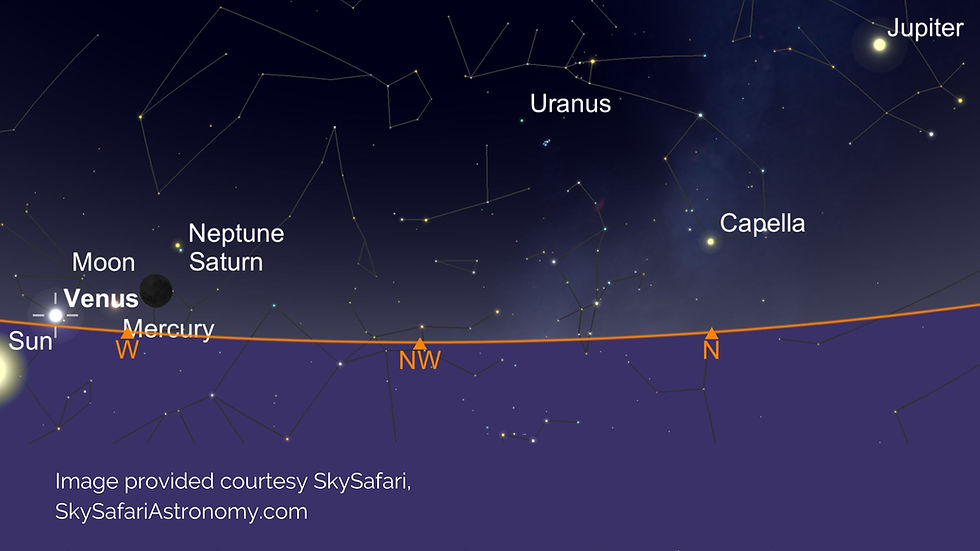
If you’ve dreamed of ticking multiple planets off your bucket list in the one night, here’s a great chance! The Sun will have only just set, but you should still be able to catch a glimpse of Venus and Mercury very low on the western horizon before they disappear from view. As the sky darkens, Saturn and Jupiter will be visible to the naked eye. To see Neptune and Uranus, you’ll need a pair of high magnification binoculars or a medium sized telescope.
When and where to look:
7.30pm, 19th February. Look to the western horizon and higher up in the north west, northern and north eastern sky.
Something Interesting:
Planetary alignments, when multiple planets are visible across the night sky in the one evening, happen on a fairly regular basis. There’s always a bit of excitement when it occurs. Planetary alignments of seven planets is rarer than an alignment of six. It’s much rarer still to witness many planets grouping together in the same area of sky. You might have a conjunction or grouping of two planets together, but when five get together, it’s breathtaking! It’s been calculated that a planetary quintuplet will occur on the evening of 8th September 2040! Venus, Jupiter, Saturn, Mars and Mercury, all naked-eye visible planets, will appear near a very thin crescent Moon after sunset. The bright star of Spica will top of the impressive lineup!

The solar system’s two largest planets adorn the evening sky this month, while the smaller inner planets linger near the Sun and remain mostly out of sight.
You’ll want to make Saturn your first target as darkness descends. The ringed planet shines at magnitude 1.0 and appears low in the west among the faint background stars of Pisces the Fish. Although Saturn stands 46° east of the Sun in early February, the ecliptic makes a shallow angle to the western horizon from mid-southern latitudes at sunset this time of year, so the planet hangs low in our sky.
The best views through a telescope come during fleeting moments of steady seeing. In mid-February, Saturn’s disk measures 16″ across while the rings span 37″ and tilt 3° to our line of sight. Also look for the planet’s largest satellite, 8th-magnitude Titan, which completes an orbit of the giant world every 16 days.
Saturn serves as a convenient guide to the outermost major planet around midmonth. On the 16th, the ringed world passes 0.9° south (upper left) of
Neptune. You should be able to spot the 8th-magnitude planet through a small scope.
Magnitude –2.5
Jupiter stands as the brightest object in February’s evening sky. The giant planet appears in the northeast as twilight fades to darkness. It moves slowly westward against the backdrop of central Gemini, some 10° above the Twins’ brightest stars, Castor and Pollux.
A telescope resolves fine detail in the gas giant’s atmospheric bands. The best views come when it climbs highest in the north during the late evening hours. Look for two parallel dark belts, one on either side of a brighter zone that coincides with Jupiter’s equator, which spans 44″ in mid-February. The planet’s four bright moons should also stand out on any clear evening.
Earth’s three closest planetary neighbors fare far worse than their more distant siblings. Venus crawls slowly away from the Sun into the evening sky while
Mars does the same in the morning sky. Yet neither achieves a significant elongation by month’s end. Venus then stands 13° from the Sun and Mars is only 12° from our star.
Orion the Hunter
Orion the Hunter is a famous summer constellation, and it is up in the early evening for you to see now. First thing in the evening, look directly to the east. The brightest star you’ll see is Sirius.
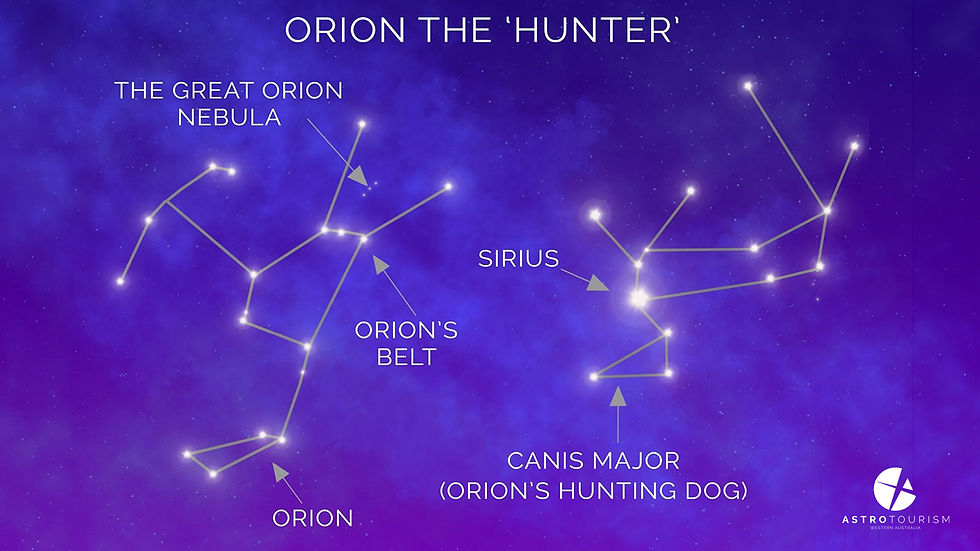
Directly to the left of Sirius is what is often referred to as ‘the Saucepan’, and it’s part of the Orion constellation. There are three bright stars in a reasonably straight line that make up the base of the saucepan, and a handle sticks out at the top right.
Orion has been known since ancient times. In Greek mythology, Orion is a mighty hunter, but his image is upside down in the southern hemisphere. The three bright stars of the base are Orion’s belt, and the saucepan handle form Orion’s sword.
With lovely summer evenings ahead, take an opportunity to marvel at the incredible constellation of Orion.
Astronomer and author Ray Norris says “There are many stories about the Orion constellation right across Australia, and they are nearly always about a group of men hunting or fishing.”
According to Norris, the Yolngu people in Arnhem Land tell a story of the three brothers in a canoe in the Orion constellation, better known as Djulpan.
The three stars in Orion’s belt are the brothers sitting side by side, with the stars Betelgeuse and Rigel marking the front and back of the canoe. The stars in Orion’s nebula represent a fish, and the stars of Orion’s sword mark out a fishing line trailing behind the canoe. “I love it because it actually looks like a canoe when you see it,” says Norris.
When to look: Early to late evening
Which direction to look: East
Something Interesting
If you have a telescope, there’s a beautiful object for you to find in Orion. The middle star of the handle of the ‘Saucepan’, is not just one star at all. When looked at through a telescope or powerful binoculars, the beautiful Orion nebula reveals itself.
A nebula is a gaseous region in space where new stars are born. The Orion Nebula has about 700 baby stars that give the glow. It is approximately 1,400 light years from Earth and is a massive region of about 24 light years in diameter.
February
A run down of events
02 February: Lunar occultation of Regulus (Leo).
08 February: Alpha Centaurids Meteor Shower peaks. Runs roughly from late January to mid-February, peaking on 8 February. This shower is best seen from Australia and New Zealand, with bright, fast meteors streaking across the pre-dawn sky. Dark, clear skies away from city lights make for the best viewing.
09 February: Last Quarter Moon.
11 February: Lunar occultation of Antares (Scorpius).
14 February: Lunar occultation of Sigma Sagittarii (Sagittarius).
16 February: Conjunction of Saturn and Neptune.
17 February: Annular Solar Eclipse.
17 February: 🌑 New Moon.
17 February: Conjunction of the Moon and Mercury.
17 February: ☄️ Comet C/2024 E1 (Wierzchos) passes perigee (Sculptor).
19 February: Lunar occultation of Mercury (Aquarius).
20 February: Conjunction of the Moon and Saturn.
24 February: First Quarter Moon.
26 February: Lunar occultation of Beta Tauri (Taurus).
27 February: Conjunction of Venus and Mercury.
27 February: Conjunction of the Moon and Jupiter.
All February: ☄️ Comet Wierzchos (C/2023 A3) remains around mag 5
For more information, check out astrogirl-au.com.
Tips for Observing the Night Sky
To get the best experience from these astronomical events, consider the following practical advice:
Find a Dark Location: Light pollution from cities can wash out faint meteors and stars. Head to rural areas or designated dark sky parks.
Check the Weather: Clear skies are essential. Use local weather forecasts to pick nights with minimal cloud cover.
Bring the Right Gear: A reclining chair or blanket helps you look up comfortably. Binoculars or a small telescope enhance planetary views.
Dress Warmly: Even in summer months, nights can get chilly, especially in elevated areas.
Use Apps or Star Charts: Mobile apps like Stellarium or Sky Guide help identify constellations, planets, and meteor shower radiants.
Plan Around Moon Phases: Aim for nights near the New Moon for the darkest skies.
Star Dome
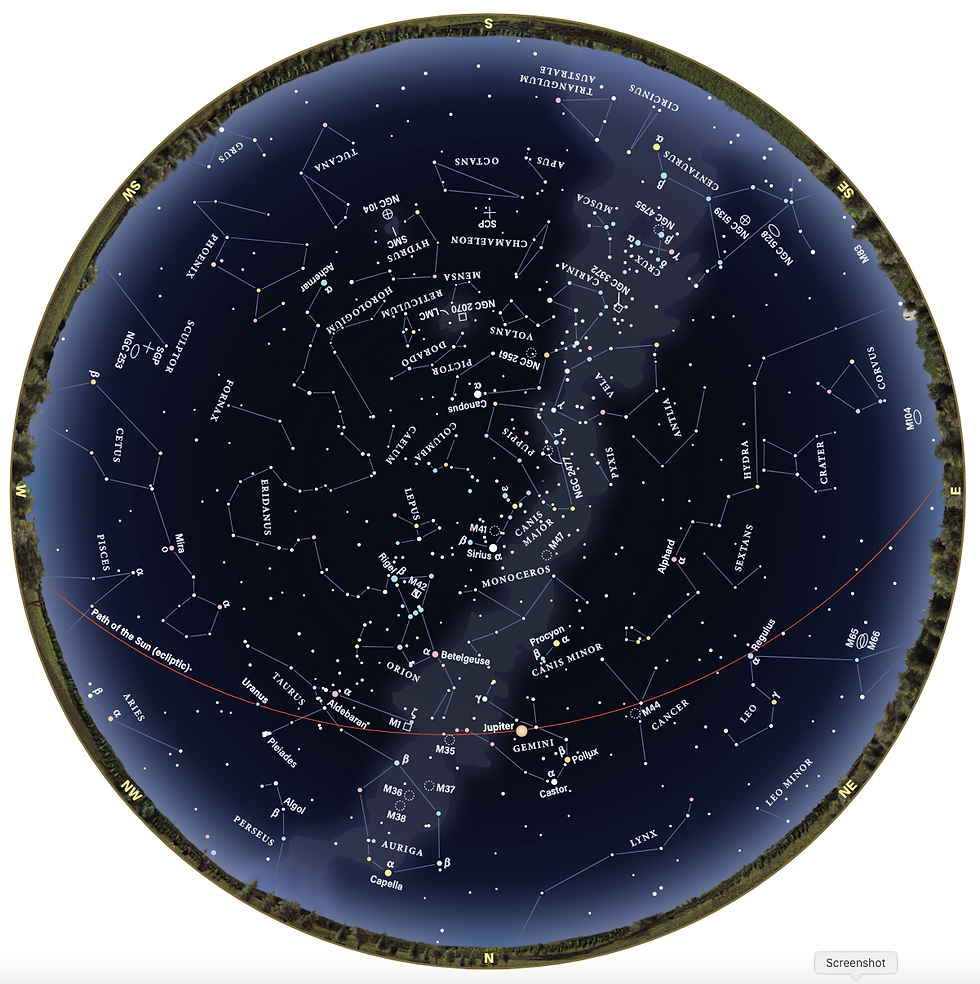
The map below portrays the sky as seen near 30° south latitude. Located inside the border are the cardinal directions and their intermediate points. To find stars, hold the map overhead and orient it so one of the labels matches the direction you’re facing. The stars above the map’s horizon now match what’s in the sky.
The all-sky map shows how the sky looks at:
10 p.m. February 19 p.m. February 158 p.m. February 28
Planets are shown at midmonth
References:
Perth Observatory
BBC Sky at Night


Comments